
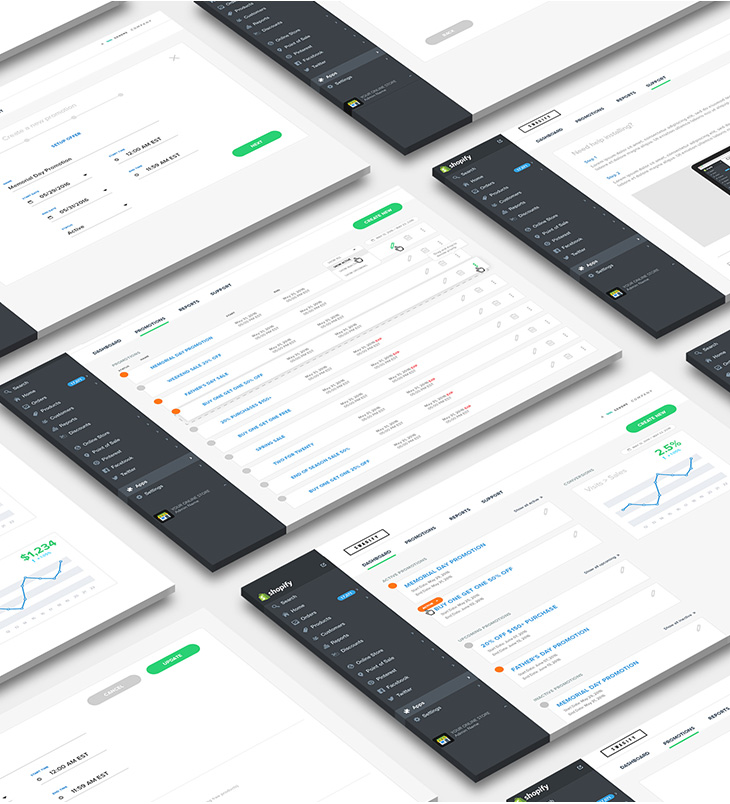
SwagifyUpsell Products. Increase Sales. Incentivize Customers.
- Product Creation
- Strategy
- Branding
- Technology Development
- UI/UX Design
Overview
Genome concepted and built Swagify in-house, for Shopify, one of today’s most popular e-commerce platforms with nearly 300,000 on-line stores. The Swagify app allows Shopfiy store owners to upsell and cross-sell products and bundles with highly customizable offers at the point of checkout based on the contents or dollar value of the customer’s shopping cart.
Swagify increases conversion rates and sales by 20%-30% by allowing store owners to create highly customizable offers. Swagify integrated feature set includes Upsell Products Based on Custom Tiers, Increase and Optimize Sales, Incentivize Customers, Boost Brand Loyalty, Flexible Campaign Controls and Real-Time Analytics.
Key Features
- Embedded Shopify App, fully integrated with the Shopify API and the Shopify Javascript SDK.
- Supports multiple concurrent promotions with different business rules and rewards
- Intuitive yet granular business rule builder to configure promotion qualification conditions, including limitations based on time, product type, or dollar value spent
- Customizable consumer messaging that can be easily branded through no-code-required in-app controls or within the code of a shop's theme templates
- Close-to-realtime reporting on promotion performance, in terms of both impressions and conversions
- Full customer support, with both documentation and live assistance in configuring a shop's theme to work with the app
App Interface
More Examples

Case study
Swagify | Digital Product Case Study | Genome Studio: strategy, craft, and momentum
Swagify | Digital Product Case Study | Genome Studio: strategy, craft, and momentum began as a question about branded merchandise workflows. The people involved needed an experience that could explain the value quickly while still leaving room for the detail behind it. We started by looking at the moments when teams organizing products for events and communities need to decide, compare, remember, or act, then used those moments to establish a clearer order for the story.
The central design challenge was turning a potentially messy catalog into a more approachable path to selection. Content, layout, and interaction were considered together so that the page could carry atmosphere without hiding the information that gives the project its purpose. Early prototypes helped the team test tone and rhythm before visual polish made any single direction feel inevitable.
The finished branded merchandise workflows experience is shaped by real conditions. People may arrive from a small screen, enter at a deep link, skim between sections, or return later looking for one specific answer. Headings, labels, imagery, and responsive behavior therefore work as a connected set of signposts. Each detail has a job in helping teams organizing products for events and communities feel oriented.
Implementation for branded merchandise workflows carried the same care into the working system. Reusable patterns make future updates easier, while thoughtful loading behavior protects the first impression. The structure can support new stories, products, or campaign moments without asking the team to rebuild the entire experience whenever the content changes.
The lasting value of Swagify | Digital Product Case Study | Genome Studio: strategy, craft, and momentum is the shared understanding it creates. Stakeholders can see how the experience supports a wider goal, content owners have a clearer way to work, and technical teams inherit decisions that communicate intent. That alignment gives this project a better chance of staying useful long after its launch moment.
Compare this branded merchandise workflows case study with other digital work, explore the supporting services, or read the studio journal for practical thinking about products and experiences. To discuss a similar challenge, visit contact.