
Eight Days A WeekThe Touring Years
- Creative Direction and Design
- Tech Development
- UI/UX
- Marketing Analytics Strategy
Overview
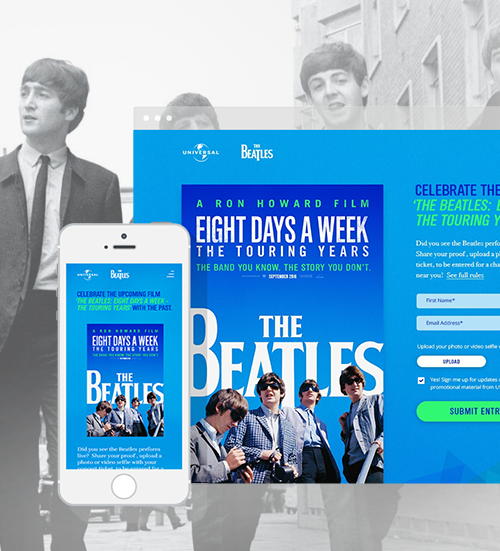
In conjunction with the film’s release, White Horse Pictures, Universal Music Group, and Apple Corps launched a promotional campaign that included an offer to The Beatles fans who saw the band in concert and still had a ticket from The Touring Years in the ‘60s. Using media like The New York Times, fans were encouraged to visit the website and upload a selfie of themselves with their ticket from the concert. The first 500 fans to participate with a valid ticket, received free movie passes for the September 2016 opening of Eight Days A Week: The Touring Years.
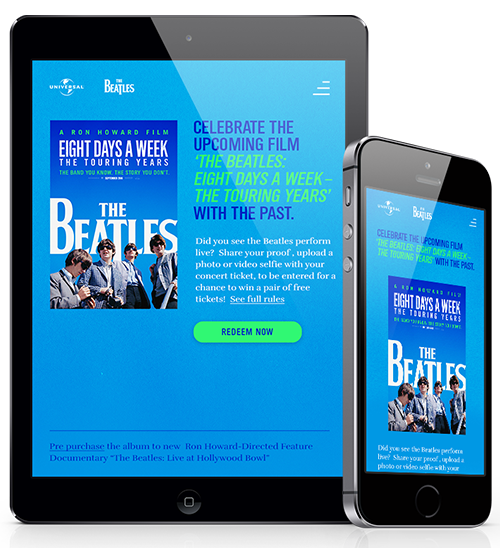
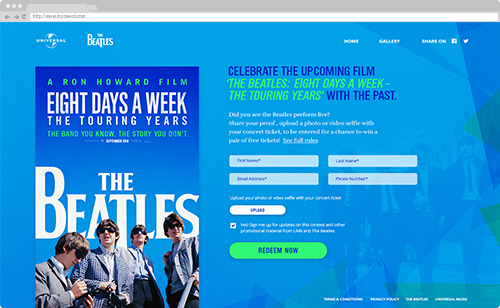
Genome built a responsive web site for the six-week campaign using key art from the film. The site captured first, last, email, phone, and featured a photo gallery of the fans who uploaded their selfies. Fan participation was strong, with more than 100 fans uploading selfies in the first few hours.
Key Features
- Cross-browser support for image and video uploads
- Integration with third-party campaign managers to store candidate emails for future marketing outreach
- Moderation queue for filtering invalid and/or inappropriate submissions
Website
More Examples
Case study
Eight Days A Week | Digital Product Case Study | Genome Studio: strategy, craft, and momentum
Eight Days A Week | Digital Product Case Study | Genome Studio: strategy, craft, and momentum began as a question about editorial storytelling. The people involved needed an experience that could explain the value quickly while still leaving room for the detail behind it. We started by looking at the moments when audiences moving through a rich archive need to decide, compare, remember, or act, then used those moments to establish a clearer order for the story.
The central design challenge was balancing film, music, chronology, and atmosphere in one engaging journey. Content, layout, and interaction were considered together so that the page could carry atmosphere without hiding the information that gives the project its purpose. Early prototypes helped the team test tone and rhythm before visual polish made any single direction feel inevitable.
The finished editorial storytelling experience is shaped by real conditions. People may arrive from a small screen, enter at a deep link, skim between sections, or return later looking for one specific answer. Headings, labels, imagery, and responsive behavior therefore work as a connected set of signposts. Each detail has a job in helping audiences moving through a rich archive feel oriented.
Implementation for editorial storytelling carried the same care into the working system. Reusable patterns make future updates easier, while thoughtful loading behavior protects the first impression. The structure can support new stories, products, or campaign moments without asking the team to rebuild the entire experience whenever the content changes.
The lasting value of Eight Days A Week | Digital Product Case Study | Genome Studio: strategy, craft, and momentum is the shared understanding it creates. Stakeholders can see how the experience supports a wider goal, content owners have a clearer way to work, and technical teams inherit decisions that communicate intent. That alignment gives this project a better chance of staying useful long after its launch moment.
Compare this editorial storytelling case study with other digital work, explore the supporting services, or read the studio journal for practical thinking about products and experiences. To discuss a similar challenge, visit contact.